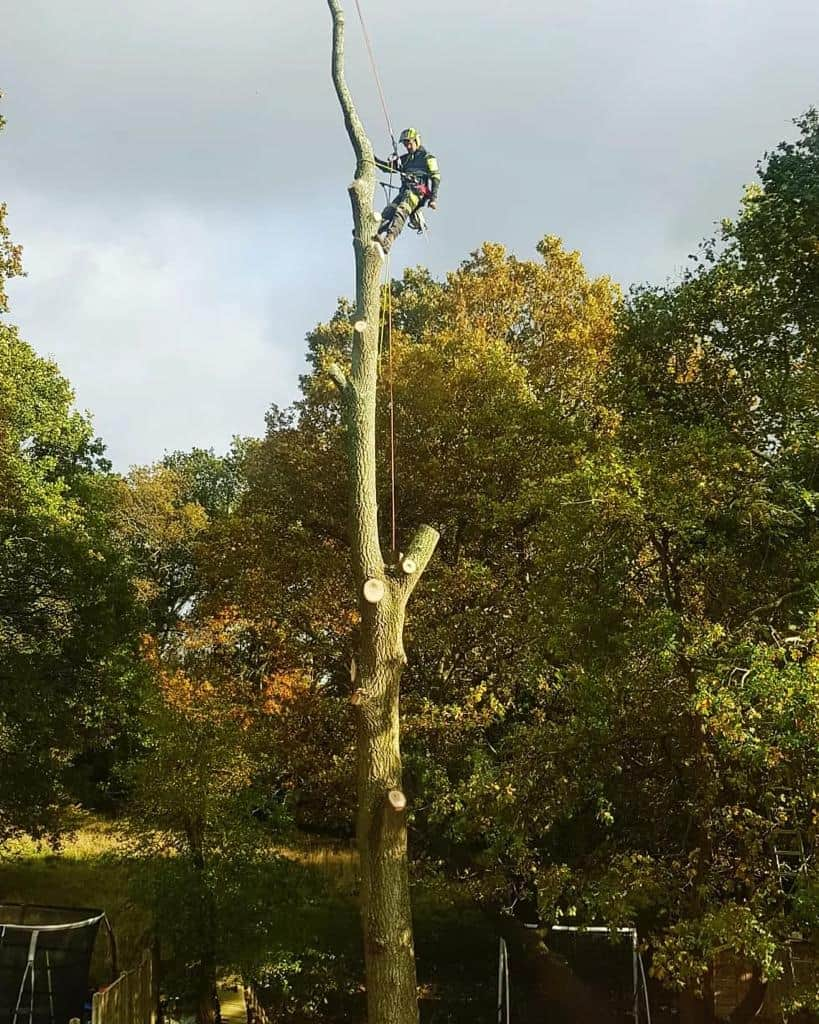
When a tree becomes overgrown, damaged or difficult to manage, complete removal is not always necessary. Professional tree surgery may be able to retain the tree while improving its structure, clearance and suitability for the surrounding garden.
In other cases, pruning would only provide a temporary response to a more serious problem. The right decision depends on the tree’s condition, stability, species, position and ability to respond to remedial work.
Deciding Whether to Retain or Remove a Tree
When Tree Surgery May Be the Better Option
Tree surgery covers several techniques designed to manage trees without removing them completely. Appropriate work may improve clearance, remove defective growth or reduce pressure on particular branches.
Retention may be suitable when:
- The tree is generally healthy and structurally sound
- Damage is confined to particular branches
- The crown has become too large for the available space
- Deadwood can be removed without affecting the main structure
- Branches are obstructing paths, buildings or garden areas
- The tree has developed an unbalanced canopy
- Selective pruning can provide sufficient clearance
- The tree is likely to respond well to the proposed work
A professional assessment is needed because different species and age groups respond differently to pruning.
Crown Reduction for an Oversized Tree
Crown reduction decreases the overall height or spread of a tree while retaining its natural framework. It may be considered where a healthy tree has outgrown its position or developed excessively long branches.
A balanced reduction should shorten suitable growth points throughout the crown rather than cutting branches indiscriminately. The amount removed must reflect the tree’s species, condition and capacity to recover.
Excessive cutting can stimulate weak regrowth, leave large wounds and spoil the tree’s natural form. A carefully planned reduction aims to create a proportionate canopy while retaining sufficient healthy foliage.
Crown Thinning and Selective Pruning
Crown thinning removes selected secondary branches to reduce density without substantially changing the tree’s overall size. It can improve light penetration and reduce the weight of crowded areas.
Selective pruning may also remove crossing, rubbing or poorly positioned branches. This work is useful when the main tree remains sound but individual parts of its canopy need attention.
Neither technique should be used as a general response to every large tree. The work must address a specific need and preserve an appropriate branch structure.
Deadwood Removal
Dead branches can develop through ageing, previous damage, shading or changes in the tree’s condition. Removing significant deadwood can reduce the likelihood of branches breaking unexpectedly over frequently used areas.
Deadwood alone does not necessarily mean the whole tree is failing. A tree surgeon can assess whether the dead branches are localised or part of a wider decline affecting the trunk, roots or major limbs.
Reshaping an Unbalanced Crown
Trees can become uneven after storm damage, branch loss or unsuitable previous pruning. An unbalanced canopy may place additional loading on one part of the tree.
Corrective pruning can sometimes redistribute the crown and improve its overall form. However, work must be proportionate; removing too much from the heavier side may create further imbalance or stress.
When Tree Removal May Be More Appropriate
Complete removal may be considered when the tree cannot be managed reliably through pruning or when its condition leaves limited scope for recovery.
Possible reasons include:
- Extensive decay in the trunk or major unions
- Severe root damage or instability
- Large structural cracks
- Widespread canopy decline
- A significant lean associated with recent movement
- Repeated failure of major branches
- Damage affecting several principal limbs
- The tree being unsuitable for its restricted position
- Previous work having left an unstable structure
No single sign should be viewed in isolation. The tree’s complete structure and surrounding environment need to be considered together.
Why Severe Decay Can Change the Recommendation
Decay can reduce the strength of the trunk, roots or branch unions. Its significance depends on location, extent and the amount of sound wood remaining.
Some trees can continue to be managed despite limited decay, while others may have lost too much structural integrity for pruning to provide a dependable solution. Removing branches can reduce loading, but it cannot restore decayed internal wood.
Root and Ground Movement
Changes around the base of a tree can provide important information about stability. Cracking or lifting soil, exposed roots and a newly developing lean may indicate movement within the root system.
Root damage may also result from soil disturbance, compaction or earlier excavation. Because much of the root system is concealed, professional assessment is particularly important when changes appear suddenly.
The Tree’s Position Matters
A tree’s condition cannot be considered separately from its surroundings. A defect carries different implications depending on whether branches could reach a building, path, parking area or frequently used part of the garden.
Available working space also affects how pruning or removal can be undertaken. In restricted gardens, sectional dismantling may be used to lower the tree in controlled pieces rather than felling it in one movement.
Why Repeated Heavy Pruning May Not Be the Answer
If a tree repeatedly outgrows its position or needs severe cutting to maintain clearance, continued pruning may gradually reduce its quality. Large wounds and vigorous regrowth can create an ongoing cycle of intervention.
In such cases, a tree surgeon should assess whether a more moderate maintenance plan is possible. If the tree cannot be retained at a suitable size without harmful cutting, removal may be the more practical long-term recommendation.
What a Professional Assessment Should Establish
Before recommending tree surgery or removal, a tree surgeon should examine:
- Overall vitality and leaf development
- Trunk condition and major unions
- Rooting area and visible ground movement
- Dead, cracked or damaged branches
- Crown balance and weight distribution
- Previous pruning work
- Clearance from nearby features
- The likely response to further pruning
- The practical options for completing the work safely
At NS Tree Surgery Billingshurst, we assess whether suitable tree surgery can retain and improve the tree before recommending complete removal.
Conclusion
Tree surgery is often the better option when a tree remains healthy and its problems can be addressed through crown reduction, selective pruning, reshaping or deadwood removal. Removal may be more appropriate where structural deterioration, instability or severe decline cannot be managed reliably.
If you are unsure which approach is suitable for a tree in your garden in Billingshurst, West Sussex, contact NS Tree Surgery Billingshurst to arrange a professional assessment. Clear advice based on the tree’s actual condition can help you choose a proportionate solution without unnecessary work.
Call us on: 01403 907 097
Click here to find out more about NS Tree Surgery Billingshurst
Click here to complete our contact form and see how we can help with your trees needs